




















Direkt zum Inhalt

Warenkorb

  • Laurence A. Rickels

    Ulrike Ottinger. Eine Autobiografie

  • N. John Habraken, Arnulf Lüchinger

    Die Träger und die Menschen. Das Ende des Massenwohnungsbau…

  • gerade nicht auf Lager
    Liz Kotz

    Words to Be Looked at. Language in 1960s Art

  • gerade nicht auf Lager
    Guy Debord

    Comments on the Society of the Spectacle

  • Michel de Certeau

    Kunst des Handelns

  • gerade nicht auf Lager
    Jacques Ranciere

    Ist Kunst widerständig?

  • Alain Badiou

    Wofür steht der Name Sarkozy?

  • gerade nicht auf Lager
    Donna Haraway

    Die Neuerfindung der Natur. Primaten, Cyborgs und Frauen.

  • gerade nicht auf Lager
    Stefanie Schulte Strathaus, Florian…

    Wer sagt denn, dass Beton nicht brennt, hast Du’s probiert?

  • gerade nicht auf Lager
    Henri Lefebvre

    Writings on Cities

  • Loretta Napoleoni

    Rogue Economics. Capitalism's New Reality

  • AD

    AD 174. Vol. 75. Nr. 2. Samantha Hardingham. The 1970'…

  • An Architektur

    An Architektur 18: Camp for Oppositional Architecture:…

  • Johan Frederik Hartle

    Der geöffnete Raum. Zur Politik der ästhetischen Form

  • An Architektur

    An Architektur 16-17

  • Vera Beyer, Jutta Voorhoeve, Anselm…

    Das Bild ist der König. Repräsentation nach Louis Marin

  • An Architektur

    An Architektur 15 / FFM 11: Europäische…

  • An Architektur

    An Architektur 14: Camp for Oppositional Architecture

  • An Architektur

    An Architektur 11-13: Theorie und Praxis der Kartografie

  • An Architektur

    An Architektur 10: Gemeinschaftsräume

  • An Architektur

    An Architektur 04-09: Krieg und die Produktion von Raum

  • IDEA Magazine

    IDEA 296. Books <preposition> graphic design

  • IDEA Magazine

    IDEA 293. Stanley Donwood / Vacances. DD-DDD / Dimensions…

  • gerade nicht auf Lager
    An Architektur

    An Architektur 01-03

  • Pro qm

    Gutschein / Voucher

  • Siegfried Kracauer

    Das Ornament der Masse. Essays

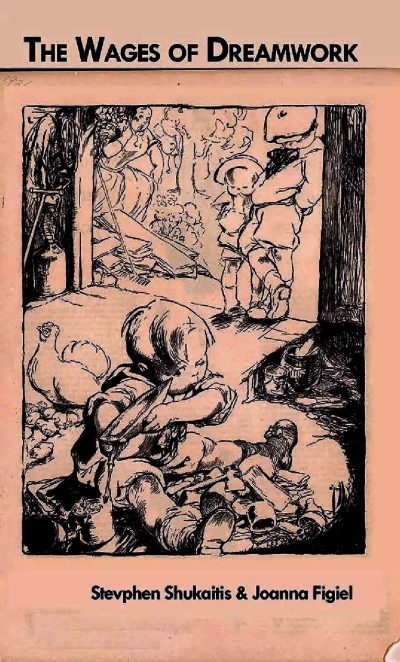
The Wages of Dreamwork.

Class Composition & the Social Reproduction of Cultural Labor

Surviving as a cultural or artistic worker in the city has never been easy. Creative workers find themselves celebrated as engines of economic growth, economic recovery and urban revitalization even as the conditions for our continued survival becomes more precarious. How can you make a living today in such a situation? That is, how to hold together the demands of paying the rent and bills while managing all the tasks necessary to support one’s practice? How to manage the tensions between creating spaces for creativity and imagination while working through the constraints posed by economic conditions?

In a more traditional workplace it is generally easy to distinguish between those who planned and managed the labor process and those who were involved in its executions: between the managers and the managed. For creative workers these distinctions become increasingly hard to make. Today the passionate and self-motivated labor of the artisan increasingly becomes the model for a self-disciplining, self-managed labor force that works harder, longer, and often for less pay precisely because of its attachment to some degree of personal fulfillment in forms of engaging work. And that ain’t no way to make a living, having to struggle three times as hard for just to have a sense of engagement in meaningful work.

The Wages of Dreamwork investigates how cultural workers in the modern metropolis manage these competing tensions and demands. Does the cultural economy treat you as a tool? If so, perhaps it’s time to rethink how to down tools in this metropolitan factory.


Stevphen Shukaitis, Joanna Figiel
The Wages of Dreamwork.

Class Composition & the Social Reproduction of Cultural Labor

Minor Compositions, 2024, 9781570274077
gerade nicht auf Lager