



















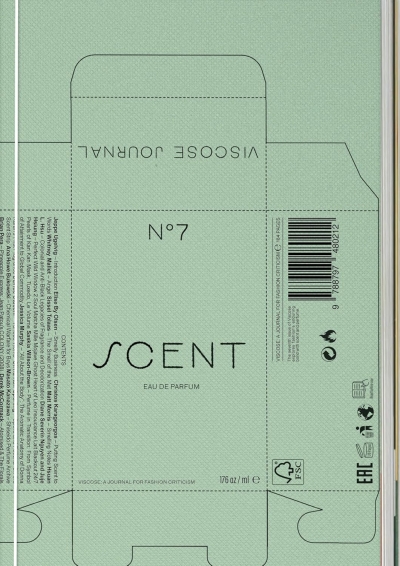
Viscose Journal 07. Scent
The seventh issue of Viscose explores fashion’s enduring bond with scent and perfume. To be sure, fashion smells. Olfactory sensations have leaked from industries of style since its inception: scent, the stuff of ancient history and myth, has been traded as precious commodities alongside textiles and garments since the world’s earliest trade routes (if for a range of social, religious, and political purposes). But the connection between scent and clothing is more profound than their commodity status. For if fashion can be understood as a “social technology” that represents self and body as culturally produced concepts, then olfaction is indeed fashion in the purest sense of the word―a supplementary limb, or a garment, as it were. Smell is a critical dimension of social appropriateness (which is how Arjun Appadurai once defined fashion), beginning, of course, with cleanliness. Smell is brutally implicated in the production of gender, ethnicity, race, and class, linking many of our social anxieties and aspirations to concrete chemical compounds that are still mostly unnamed. This is the paradox of scent: much like fashion, olfaction is a technology of supplementing the body but the difference is that this extension happens in the realm of the atmospheric―a realm that eludes the classic semiotic register in which we tend to discuss not only fashion but socially legible bodies. The atmospheric is where semiotics dematerializes, literally evaporates―and thus also where standard writing ends. To understand and write about scent is enormously difficult: this is no doubt what galvanizes the genre of scent writing so profoundly. Viscose 07 examines scent through a variety of lenses, observing its historical and contemporary role in fashion culture. The issue seeks out histories of projects―mainly developed with or by artists and designers―who have embraced and involved smell as a medium of possibility and knowledge production, gesturing to histories of manufacturing, trade, branding, and commerce, but also sexuality, desire, identity, and memory. With respect to the abstract knowledge of scent, we are in pursuit of accounts ranging from literature to philosophy that attempt to synthesize, much like perfume itself, the sensorial, capitalist, artistic, and scientific forces that make up scent in our modern world.